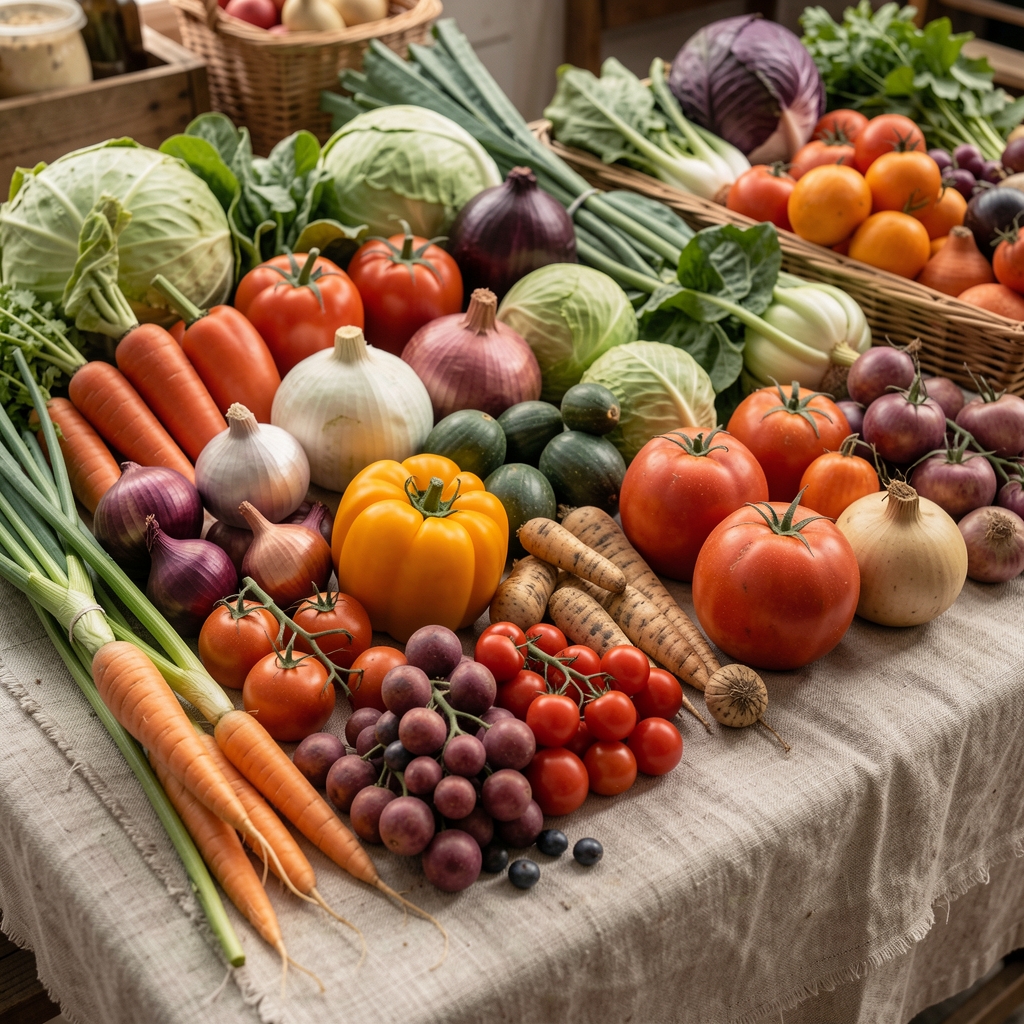
A spring market stall has a particular grammar of its own. The items arranged along its front edge are not arranged by the vendor so much as by the season, which has its own logic of succession, colour, and readiness. What that grammar suggests about how a kitchen might be organised is the subject of this inquiry.
The Calendar as a Kitchen Instruction
There is a tendency, in the contemporary discussion of healthy eating habits, to regard vegetables and fruits as interchangeable across all twelve months. A strawberry in January is presented as equivalent to a strawberry in June, provided its nutritional profile on paper remains consistent. What this account misses is the degree to which the season of a vegetable or fruit — its moment of readiness, in the language of the market — shapes not just its flavour but its relationship to the cook who works with it.
The seasonal kitchen is not a romanticised concept. It is, in practice, a constraint that generates a kind of discipline. When asparagus is in season, it appears. When it is not, something else appears. The cook who follows this rhythm does not do so out of ideology but out of the recognition that what is at its peak of readiness is also, almost invariably, the easiest thing to cook well. The ingredient cooperates with the cook when it is in its proper season in a way that out-of-season produce does not.
These observations come from a series of notes kept across one full calendar year in a kitchen in central London, with regular visits to two market stalls and a greengrocer that had a policy of stocking only what was currently in domestic or near-domestic season. The notes recorded what was purchased, what was prepared, and, crucially, what was eventually not eaten — the remains that pointed toward the limits of the cook's engagement with a given ingredient.
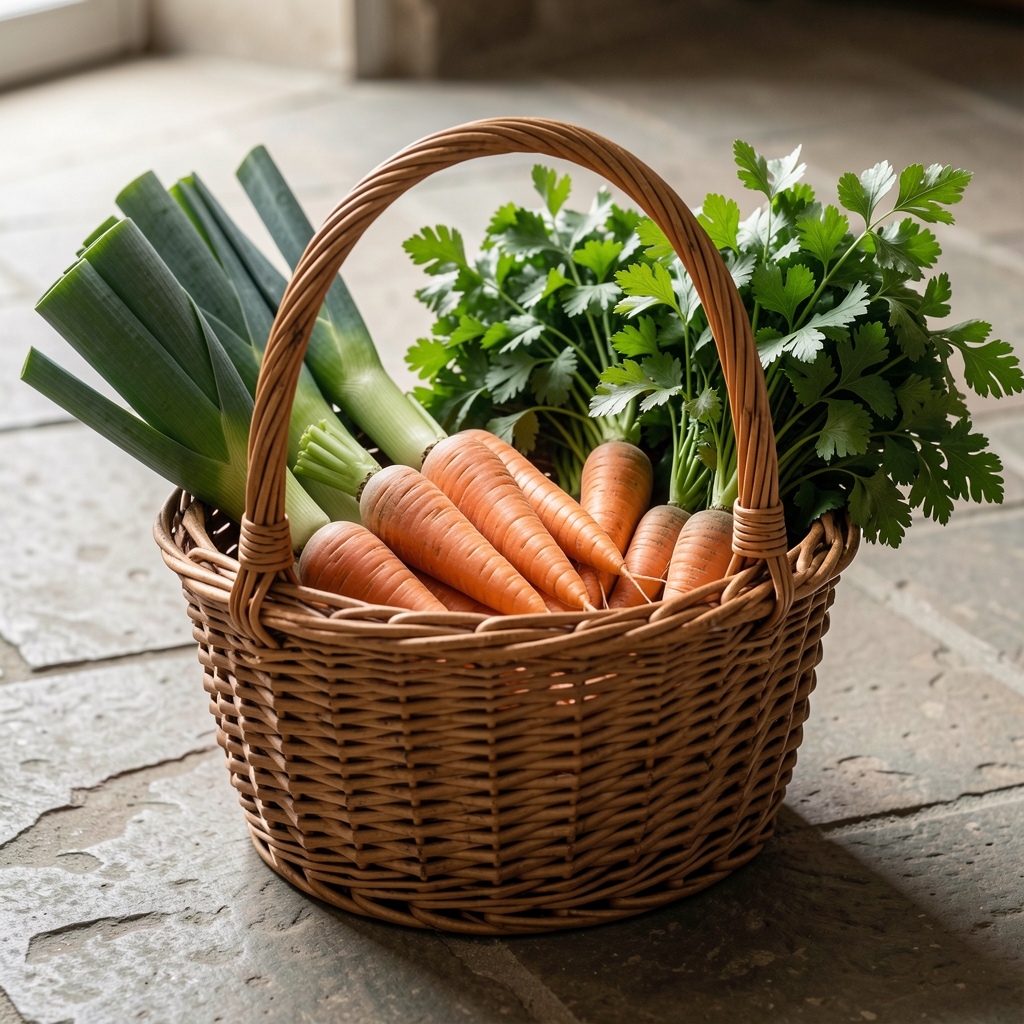
Colour as an Indicator of Variety
Nutritionist guidance on the composition of a balanced plate frequently references the importance of colour as a practical proxy for nutrient variety. The instruction to include several colours in a single meal is, at its simplest, a way of ensuring that a range of vegetable families is represented without requiring the cook to maintain detailed knowledge of micronutrient profiles. The guidance is sound; the application of it, in practice, is more interesting than its simplicity suggests.
What the year of field notes recorded is that colour variety in a meal correlates closely with seasonal availability. A plate assembled in mid-winter from what is in peak condition in that season — root vegetables in their darker, earthier registers, the deep green of kale and cavolo nero, the pale cream of celeriac — achieves a different kind of colour variety than a plate assembled from summer produce, but it achieves it nonetheless. The winter palette is narrower in its hue range but deeper in its saturation; the summer palette is broader and more vivid.
This observation points to a useful practical insight: the instruction to eat varied colours is best understood as an instruction to eat seasonally, since seasonal eating naturally produces the variety of colour that the instruction is trying to achieve. The two practices are, in a meaningful sense, the same practice described from different entry points.
"The seasonal kitchen is not a romanticised concept. It is, in practice, a constraint that generates a kind of discipline: what is at its peak of readiness is also, almost invariably, the easiest thing to cook well."
The Gut-Friendly Properties of Fibre-Rich Seasonal Produce
A recurring subject in the published research on everyday nutrition is the relationship between dietary fibre and the functioning of the gut. The evidence base here is substantial enough that it has moved from specialist literature into mainstream nutritional guidance: most adults in the United Kingdom consume significantly less dietary fibre than the recommended daily reference value, and the consequences of this shortfall are broadly understood.
What is less often noted in the popular discussion of this subject is that seasonal vegetables and fruits are, across the calendar year, among the most reliable sources of dietary fibre available in a kitchen that is not oriented around processed or fortified foods. Legumes, root vegetables, brassicas, whole grains when incorporated alongside seasonal produce — all of these contribute to the fibre intake in a way that is consistent, varied, and, in the seasonal kitchen, automatic.
The field notes recorded a particular pattern here that is worth describing. In the seasons when the kitchen contained the greatest variety of vegetables — late summer into early autumn, when allotment and market availability is at its widest — the notes also recorded the fewest occurrences of what was described as unsatisfying eating: meals that left a sense of incompleteness or a rapid return of appetite. The correlation between vegetable variety and the sense of sufficiency held, with some variability, across the full year of notes.

Preparation as an Act of Attention
The relationship between the preparation of seasonal vegetables and the quality of attention given to a meal deserves more consideration than it typically receives. The washing, chopping, and sometimes peeling of fresh produce is, in the contemporary kitchen, often regarded as an inconvenience — something to be minimised or circumvented through pre-prepared alternatives. The field notes suggest that this framing misses something.
On the occasions when preparation was undertaken with some deliberateness — when the cutting of a fennel bulb, for example, was given the attention that the particular texture and structure of a fennel bulb rewards — the meal that followed was consistently described as more satisfying than a meal assembled with equivalent ingredients but less preparation attention. The act of preparation appeared to function as a kind of priming: it oriented the cook's attention toward the meal before the meal began, producing a different quality of engagement with the eating that followed.
This observation connects to a broader published body of work on the relationship between food preparation and attentive eating, which suggests that the processes of preparation and consumption are not wholly distinct: they form a continuous arc of engagement that begins before the first bite and extends through the last. The seasonal kitchen, by requiring some degree of preparation engagement — since seasonal vegetables arrive in forms that require work — may support this arc in ways that highly processed alternatives do not.
Weight and Satiety Across the Seasonal Cycle
The question of weight management in relation to seasonal eating is one that the field notes address only obliquely, since they were not kept with this question in mind. What they do record, however, is a pattern that corresponds to observations in the published literature on seasonal eating and energy intake.
The winter season, with its heavier, denser seasonal produce and its natural reduction in light and outdoor activity, corresponds in the notes with a gravitational pull toward richer, more calorie-dense preparations. The spring and summer seasons, with their abundance of lighter, higher-water-content produce — cucumber, courgette, tomato, summer salad leaves — correspond with a natural lightening of the plate without deliberate restriction. The body, it seems, has its own seasonal intelligence, and a kitchen stocked seasonally tends to support rather than resist that intelligence.
This is not a directive for seasonal eating as a weight management strategy. It is, rather, an observation that the calendar and the body share a rhythm that an attentive cook can work with rather than against. The portion sizes in the field notes varied considerably across the year; the sense of appropriate fullness did not. The body appeared to calibrate itself against what was available, provided what was available was itself calibrated to the season.
- ● Seasonal availability and colour variety in a meal describe the same nutritional principle from two different entry points; following one naturally produces the other.
- ● The act of preparing fresh seasonal produce functions as a form of attentive engagement with the meal, supporting the quality of the eating that follows.
- ● Gut-friendly fibre intake is most consistently achieved in a kitchen organised around seasonal whole produce rather than processed alternatives.
- ● The body and the seasonal calendar share a rhythm; a kitchen stocked seasonally tends to support rather than resist the body's natural appetite adjustments across the year.